
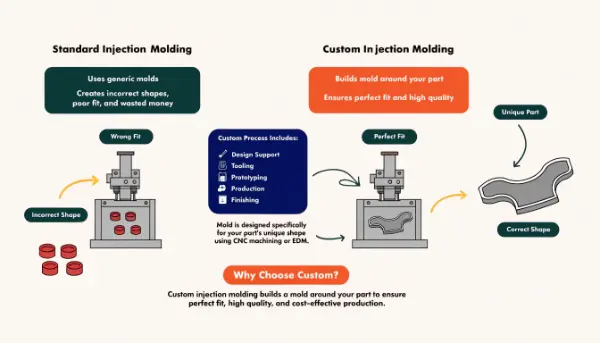
When you need plastic parts that match your exact design, standard molds will not work. You face wrong shapes, poor fit, and wasted money. Custom injection molding service solves this by building a mold around your specific part, so every piece matches your requirements.
Custom injection molding service is a manufacturing service where a company designs and produces plastic parts based on your specific design and needs. It uses a purpose-built mold, often made with CNC machining or EDM, to create unique shapes. The service usually covers design support, tooling, prototyping, production, and finishing.
I have spent years inside the mold industry, both as a factory employee and later as a business owner. I have seen how the right custom service can make or break a product. Let me walk you through the key questions buyers like you ask most often.
How much does a custom injection mold cost?
You want clear numbers before you commit. Hidden costs and vague quotes create real risk for your budget. The truth is, mold cost depends on many factors, but you can predict it once you know what drives the price.
A custom injection mold usually costs between $1,000 and $80,000 or more. Simple molds start low. Complex molds with many cavities, tight tolerances, and hardened steel cost much more.
What drives the mold cost?
The price of a mold comes from several clear factors. I always break these down for my clients so they understand where their money goes.
| Factor | Impact on Cost |
|---|---|
| Part complexity | More features, higher cost |
| Mold steel type | Hardened steel costs more than aluminum |
| Number of cavities | More cavities, higher tooling price |
| Tolerances | Tight tolerances raise machining cost |
| Surface finish | Polished or textured adds cost |
| Production volume | High volume needs durable, costly molds |
A prototype mold made from soft aluminum may cost a few thousand dollars. A production mold built from hardened steel for millions of parts can reach tens of thousands. I tell buyers to match the mold type to the real production need. You should never overpay for a steel mold when a soft tool fits a small run. This choice saves both money and lead time.
What is injection molding used for?
You may wonder if this process fits your product. Picking the wrong method wastes time and money. Injection molding fits a huge range of products, which is why so many industries rely on it.
Injection molding is used to make plastic parts at high volume with consistent quality. It serves industries like automotive, medical, electronics, packaging, and consumer goods.
Where do these parts go?
Injection molding shapes the plastic parts in almost every product you touch. I have supplied parts for many of these fields over the years.
| Industry | Example Parts |
|---|---|
| Automotive | Bumpers, clips, housings |
| Medical | Syringes, device casings |
| Electronics | Connectors, enclosures |
| Packaging | Caps, containers, lids |
| Consumer | Toys, tools, appliances |
The process works best when you need many identical parts. Once the mold is ready, each cycle produces parts in seconds. This makes the cost per part very low at high volume. The method also supports overmolding, insert molding, and surface finishing. These extra steps let you build complex parts in fewer stages. For a sourcing engineer, this means fewer suppliers and lower assembly risk. I often guide clients to combine features into one molded part to cut total cost.
What is the hourly rate for injection molding?
You need to forecast production cost, not just tooling. An unclear hourly rate makes your unit price hard to predict. Machine rates vary, but they follow a clear logic based on machine size and region.
The hourly rate for injection molding usually ranges from $15 to $90 per hour. Small machines cost less. Large tonnage machines and skilled labor cost more.
What affects the hourly rate?
The hourly rate ties directly to the machine and the labor behind it. I always ask clients about their part size first, because that sets the machine tonnage.
| Factor | Effect on Rate |
|---|---|
| Machine tonnage | Larger machines cost more per hour |
| Region | Labor cost varies by country |
| Automation | Robots can lower labor cost |
| Cycle time | Faster cycles lower part cost |
The hourly rate alone does not tell you the part price. You must combine it with cycle time and cavity count. A machine at $30 per hour that makes 4 parts every 20 seconds gives a very low cost per part. I help buyers calculate this full picture. This way you compare suppliers fairly. A low hourly rate means little if the cycle time runs long. Smart sourcing looks at the total output per hour, not just the rate.
What is the typical injection molding salary?
You may research this to understand supplier cost or your own career path. Wrong assumptions about labor cost can skew your quotes. Salaries differ by role and region, but they follow steady patterns.
A typical injection molding salary ranges from $35,000 to $75,000 per year in North America. Operators earn less. Engineers and managers earn more.
How do roles compare?
The salary depends heavily on the role and skill level. I have worked with people across all these positions during my factory years.
| Role | Typical Salary Range |
|---|---|
| Machine operator | $35,000 – $45,000 |
| Process technician | $45,000 – $60,000 |
| Mold engineer | $60,000 – $80,000 |
| Plant manager | $70,000 – $100,000 |
These numbers shape your supplier’s cost base. A factory in a low-wage region offers lower part prices. A factory with skilled engineers gives better DFM support and fewer defects. As a buyer, you must weigh both. The cheapest labor does not always give the best total value. I always tell clients to value strong engineering support. A good mold engineer can cut your cost early through smart design advice. This saves far more than a small labor gap.
Conclusion
Custom injection molding builds parts around your exact design. Mold cost, hourly rate, and labor all shape your final price. Choose partners who add real engineering value.
Planning a live project? Review our custom injection molding service scope before preparing a drawing-specific RFQ.