
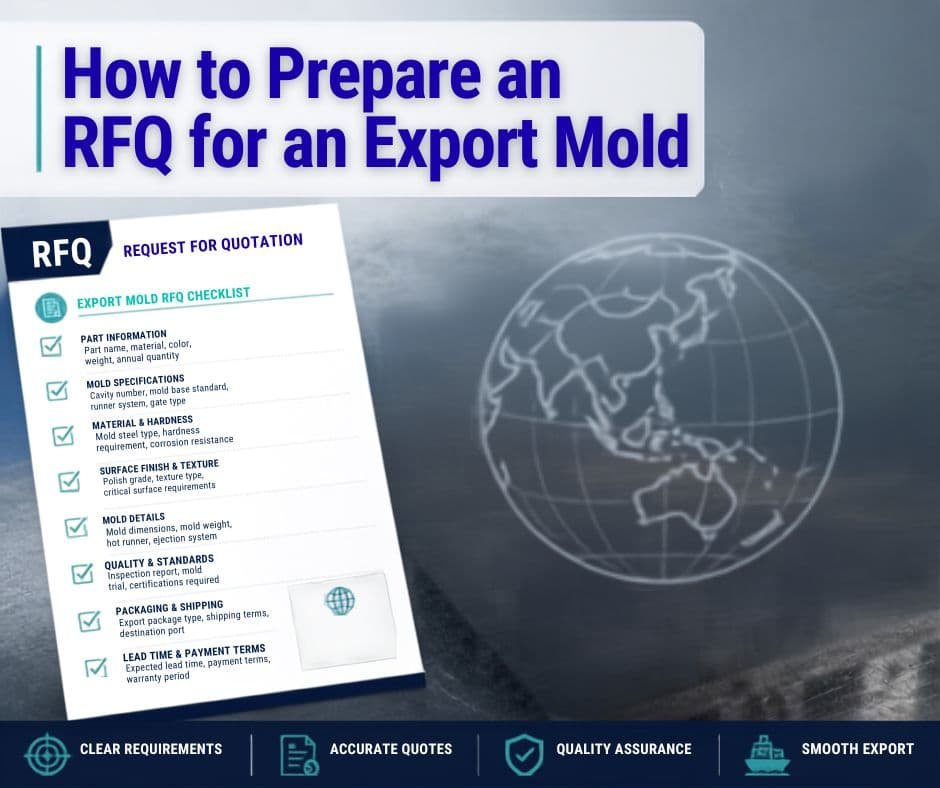
While comparing quotes, when there is room for assumptions, you are comparing guesses more than quotations. But if an RFQ is there it tells all the details – tool life, volume, material, and press size. When the supplier has complete details and there is no assumption left, then they are actually bidding on the same job.
Let’s see here how to prepare an RFQ for an export mold.
| Question | Answer |
|---|---|
| How to prepare an RFQ for an export mold? | In an export mold RFQ there are part details, material, mold standards, cavity count, production volume, delivery terms, and quality requirements. |
What Is an Export Mold RFQ?
A formal document that is sent to a mold maker to request cost, lead time, and scope of the project means request for quotation (RFQ). When a mold will be manufactured by a supplier from overseas and shipped to some other country at that time an export mold RFQ is prepared.1
It has all the details about technical specifications, standards, and commercial terms.2 All these will help in developing accurate quotations.
Export Molds vs. Local Molds: What Changes in the RFQ?
You get the tool made locally or overseas, you will find that the basic information is the same. So what makes the difference? Well, it is when something goes wrong after delivery..
Let’s say your mold maker is local. If you experience any problem with a fitting, component, or trial part, it is easy to resolve. But here instead of local if it is an export mold, then what? Now mending the same problem means another round of shipping, customs clearance, and production delays. So more expense. That is why an export RFQ needs to be more specific about the details that affect installation, acceptance, and delivery.
Equipment & Material Specifications
In order to receive an accurate quote, you need to send over your machine requirements, resin grade, target mold life, quality standards, and delivery location. Along with them attach your terms for T1 samples and shipping too. Here if standard components are required, do not forget to name the preferred brands.
T1 Acceptance & Correction Terms
Your RFQ should define T1 sample quantities, expected inspection reports, and who holds financial responsibility if the first trial does not meet the drawing. Agreeing on the correction terms before cutting off the steel prevents any disputes later.
Deliverables Scope
Shipping terms and destination should be present in the baseline quote rather than treating delivery as an add-on cost. Wondering why? You must know that packaging, rust protection, spare parts, documentation, Incoterms, and freight responsibility; all these can change the real cost of an export mold.
How to Prepare an RFQ for an Export Mold – 10 Information Categories
Now let’s see how RFQ information affects the quotation; here are your injection molding RFQ requirements. Take a look:
| RFQ Requirement | What to Include | Why It Matters |
|---|---|---|
| 1. Part Information | part name part number annual volume drawing revision | All these details prevent any wrong design or revision from being used. |
| 2. 3D CAD Files | STEP/IGES files and related mating parts | It helps the mold maker to understand fit and assembly of the parts without any confusion. |
| 3. 2D Drawing | critical dimensions tolerances inspection points | The drawings define the measurements that need to be in control. |
| 4. Plastic Material | Exact resin brand and grade, not just the material family | Material grade affects shrinkage, tooling, and mold life |
| 5. Production & Machine Details | annual/lifetime volume injection machine specifications | It helps in determining mold construction and compatibility. |
| 6. Surface Finish | polish texture grain specific finish requirements | Finish requirements can significantly affect tooling cost |
| 7. Mold Components | Preferred standard-component brands, gate and cooling preferences | It makes maintenance and replacement easier. |
| 8. T1 Trial Requirements | sampling requirements inspection criteria responsibility for corrections | Agreeing on all these details beforehand eliminates the scope of any disputes later. |
| 9. Export & Spare Parts | export packaging rust protection spare components mold documentation | Fulfillment of all the details are important because it protects the mold during international shipping and supports maintenance. |
| 10. Commercial Terms | price payment milestones delivery date ownership warranty | These details help in keeping commercial expectations clear before the start of production. |
What Should You Define and What Should the Mold Maker Recommend?
An export mold RFQ is effective only if it clearly defines the requirements that cannot change. But it should also be flexible for the mold maker to let them optimize the tooling design.
When you are thinking about how to prepare an RFQ for an export mold , we would like to add that your RFQ will be best only when the buyer will specify what the mold must achieve, and the mold maker should recommend how to achieve it.
How Much Control Should the Buyer Have?
| Buyer Defines | Discuss Together | Mold Maker Recommends |
|---|---|---|
| Part geometry and CAD data | Cavity count | Gate type and location |
| Resin grade | Target cycle-time | Runner system |
| Tolerances and quality requirements | Mold size | Cooling-channel layout |
| Annual production volume | Press selection | Ejection system |
| Program/mold life | Cost vs. capacity | Steel grade |
| Available press limitations | ROI | Tooling architecture |
Mark flexible specifications as “Open for Recommendation.”
For example, in place of :
Cavity Count: 8 cavities required
You can write:
Cavity Count: OPEN FOR RECOMMENDATION. Please recommend optimal cavitation based on 100,000 parts/year, target cycle time, available press capacity and ROI.
Mold makers feel the flexibility to offer a better solution with explanation for it.
A Simple Rule for Your RFQ
Properly define all the specifications that can not change and also discuss what will affect the cost and performance. Leave the things on the mold maker that require tooling expertise.
For example, the buyer can define part geometry, resin grade, quality requirements, production volume and available machine limitations.
Now, the mold maker can recommend the cavity count, gate location, runner system, cooling layout, ejection method and steel selection.
Sounds good?
This approach will make it easier to compare supplier quotations. How? It is because you are not simply comparing different mold prices, instead you are comparing the design assumptions behind those prices.
Before You Approve the Recommendation
You can ask two mold makers to justify their recommendation when they have different solutions. You can do so by asking:
- What is the reason behind choosing the particular number of cavities?
- What cycle time and production capacity are you assuming?
- Why do you find this runner system the best choice for the part?
- What press size will you recommend?
- How will your recommendation affect mold cost and maintenance?
- What production benefit do we get from this design?
This is the technical discussion between buyer and mold maker. But here also the buyer is in control of the requirements. This matters the most.
Worked Example: How Missing RFQ Details Affect Mold Quotes
Two completely different mold quotes for the same part and same annual volume! Why?
The origin of this issue even before the preparation of the quotation. Your RFQ is the one who is responsible for these price differences. It leaves too much space for assumptions.
🚩 RFQ #1 — Too Much Room for Assumptions
“Please quote an injection mold for the attached housing. Material: PA66. Quantity: 100,000 pieces/year.”
You might be thinking that this much information is enough to request a quote. But it isn’t. Yes, it’s true, the supplier has to do a lot of guess work here. Like:
- Exact resin grade
- Required mold life
- Part quality requirements
- Cosmetic requirements
- Inspection and validation
- T1 requirements
- Packaging and shipping
- Commercial terms
Now these assumptions will change the mold design, tooling cost, and hence the quotation too.
✅ RFQ #2 — Now Suppliers Are Quoting the Same Job with More Detailed RFQ
| RFQ must define | Example |
|---|---|
| Part & tooling | Controlled CAD, 2D drawing, required mold life |
| Material | PA66 GF30, exact resin grade |
| Production | 100,000/year; 500,000 lifetime |
| Quality | 3 critical dimensions + tolerances |
| Appearance | Well defined cosmetic surfaces and required finish |
| Validation | T1 quantity + inspection requirements |
| Logistics | Delivery location in Germany and packaging requirements |
| Commercial | Payment terms and warranty |
The difference is clear that a good RFQ should define only the requirements and not tell the mold maker how to build it.
When every supplier receives the same material grade, production volume, mold-life requirement, quality expectations, and commercial scope, making quotations for them becomes easier too.
Moreover, their quotes also become much easier to compare.
Somehow there is a possibility that even now one supplier may still recommend two cavities while another recommends four. But that’s completely fine. Now, the difference is in a design decision and not in assumptions hidden inside the quote.
How to Compare Export Mold Quotations Fairly
Before looking at the final price tag on an export mold quotation, you must normalize the scope.
While comparing a $20,000 quote directly to a $25,000 quote, at first $20,000 looks better. But if you take a closer look, this comparison will tell a different story.
One supplier included hot runners, hardened steel, and air freight while the other quoted pre-hardened steel, a cold runner, and factory-gate pickup. The $5,000 difference is therefore not simply a difference in the supplier’s margin. The two suppliers are not quoting exactly the same scope.
So, what’s the point of comparison here?
To compare an injection mold quotation fairly, here are the important technical and commercial details side-by-side: :
| Evaluation Item | Supplier A | Supplier B |
|---|---|---|
| Cavity count | 2-cavity | 2-cavity |
| Mold steel | P20 (pre-hardened) | 1.2343 / H13 (hardened) |
| Mold life | 300,000 shots | 1,000,000 shots |
| Runner system | Cold runner | Hot runner (Yudo/Mold-Masters) |
| Gate system | Sub-gate | Valve gate |
| Estimated cycle time | 32 seconds | 22 seconds |
| T1 sampling scope | 10 parts, basic measurement | 50 parts, full CMM & FAI |
| Inspection & reports | Visual check only | Full dimensional report + resin cert |
| Correction rounds | 1 round included | Up to 3 rounds included |
| Lead time | 6 weeks to T1 | 8 weeks to T1 |
| Warranty | 1 year / 300k shots | 2 years / 1M shots |
| Incoterms | EXW (Ex Works) | DDP (Delivered Duty Paid) |
| Shipping & packing | Standard box (freight extra) | Seaworthy crate + anti-rust treatment |
| Exclusions | Hot runner spare parts | None |
| Total Tooling Price | $20,000 | $25,000 |
The $20,000 quote may appear cheaper, but the buyer has to pay for freight, duties, excluded hot-runner items, and other costs later. Whereas Supplier B’s higher price may have several of these items from the beginning.
A quick buyer check: If one supplier is $5,000 cheaper, don’t ask only why the other supplier is more expensive.
Check the shipping terms, mold life, runner system, inspection requirements, correction rounds, warranty, and exclusions. Once these items are normalized, the comparison becomes much clearer.
The goal is not necessarily to select the injection molding supplier with the lowest quoted price. It is to understand what you are getting for that price and what the mold will actually cost you by the time it is delivered, validated, and ready for production.
Export Mold RFQ Checklist
Before sending an RFQ to an overseas mold maker, take a few minutes to check whether the supplier has enough information to quote the job without making too many assumptions.
Use this injection mold RFQ checklist before you send the RFQ.
Part data
- Part number and revision
- 3D CAD
- 2D drawing
- Critical dimensions/GD\&T
- Cosmetic requirements
Material
- Manufacturer
- Exact resin grade
- Reinforcement/additives
- Color
- Regrind requirements
Production
- Annual volume
- Lifetime volume
- Mold life
- Production location
Tooling
- Cavity requirement/recommendation
- Mold standard
- Steel requirement if specified
- Runner/gate requirements if specified
Quality
- T1 quantity
- Inspection requirements
- CMM/FAI if required
- Acceptance criteria
Export/commercial
- Destination
- Delivery location
- Incoterm
- Shipping method
- Packaging
- Lead time
- Payment terms
- Warranty
- Ownership
Before You Send the RFQ
Read through the RFQ once from the supplier’s point of view. Is there anything important they would have to guess?
Final Framework: Prepare, Clarify, Standardize, Compare
A good RFQ makes the comparison easier later.
- Prepare the part, material, production, quality, and commercial information.
- Clarify anything that could affect the tooling cost or scope.
- Standardize the injection molding RFQ requirements so every supplier is quoting the same job.
- Compare the technical scope and total cost—not just the number at the bottom of the quotation
Need help with your next mold project? CustomMoldHub can help you prepare a clear tooling RFQ.
Frequently Asked Questions
What are the common types of RFQs?
Among the different types of RFQs there are standard RFQs, formal RFQs, informal RFQs, competitive RFQs, and eRFQs sent through online procurement systems. For an export mold, the RFQ should clearly cover tooling, material, quality, production, delivery, shipping, and commercial requirements. .
What mistakes should you avoid when preparing an RFQ?
Look for all the important requirements and do not leave anything without explanation. Avoid missing or outdated drawings, unclear material grades, undefined production volumes, vague quality requirements, and incomplete delivery terms. .
Should you send an RFQ or RFP first?
It depends on the project. Use an RFP when you want suppliers to propose a solution. Use an RFQ when the requirements are already clear and you mainly need comparable pricing. For a well-defined export mold, an RFQ is usually sufficient.
-
"Common Export Documents – International Trade Administration", https://www.trade.gov/common-export-documents. International procurement typically requires modified RFQ documentation to address cross-border shipping, customs requirements, and regulatory compliance, though specific terminology varies by industry and region. Evidence role: general_support; source type: education. Supports: the use of specialized RFQ documentation in international manufacturing procurement. Scope note: General procurement sources may not specifically use the term ‘export mold RFQ’ as this appears to be industry-specific terminology within tooling and manufacturing sectors. ↩
-
"RFQ Process Explained: Steps, Examples, and Best Practices", https://simfoni.com/rfq-process/. Standard RFQ documents in manufacturing procurement generally include technical specifications, quality standards, delivery requirements, and commercial terms to enable suppliers to provide accurate and comparable quotations. Evidence role: general_support; source type: education. Supports: the standard components and information typically included in manufacturing RFQ documents. ↩
For drawing-specific support, review our available tooling and molding services before submitting your export-mold RFQ.