
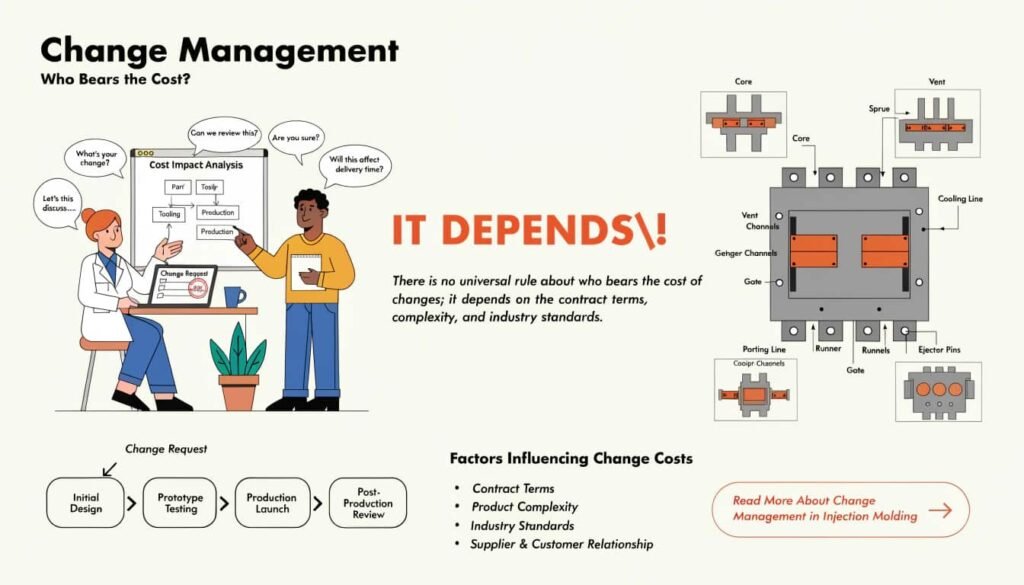
Changes can occur even after the approval of the design. Research on design changes1 shows that changes are a common part of product development and injection molding process. But the question remains? Who is responsible for financial burden in the event of any change?
The answer is – IT DEPENDS! Please note that there is no universal or a written rule about who will bear the responsibility of the change2; whether the customer or the supplier. It can either be one or both of them. Know more in this guide.
| Question | Direct Answer |
|---|---|
| Who pays for engineering changes after design approval? | Usually the buyer pays when they request changes to an approved design, material, or tooling requirement. The supplier generally pays when correcting errors or nonconforming work on its side. |
Important to Understand – What Does “Design Approval” Actually Mean?
The phrase, “The Design was Approved,” is one of the reasons why disputes happen during the manufacturing process. It is not wise to treat this phrase as a clear statement because it can have different meanings, because in the manufacturing world it means various other things.
To understand this completely, one must understand the different stages of design approval.
Part Design Approval
The client approves the product’s geometry, which includes-
- CAD model
- Dimensions
- Tolerances
- 2D drawing
- Materials
DFM Approval
The supplier identifies the potential manufacturing-related issues and proposes solutions to the client, who then approves them. At this stage, the design may become more suitable than the original CAD file.
Mold Design Approval
The client may or may not review or approve the specific elements or the complete tooling design. Depending on the project, this may involve:
- Gate’s location
- Arrangement of the cavity
- Parting line
It is important to note that the level of customer approval differs for every project.
Tooling Approval
This is a crucial commercial milestone where the client approves the tooling scope and the supplier may begin mold manufacturing.
Sample Approval
Once the supplier manufactures the sample, the client can either approve it, suggest some changes, or reject it completely.
The point worth noting here is that, “approved design,” is vague. To tackle this, specify or check for the approved document, file revision, specification or stage.
After the approval, once everything is set, it becomes easy to identify whether the client has proposed a new change or the supplier has failed to deliver what was approved.
What Design Approval Does Not Mean?
Approving one stage does not automatically mean that all future changes are included in the original price. For example, approving the part design does not mean the buyer has approved the mold design. Similarly, approving the mold design does not mean later customer-requested changes are free.
Always document the approved revision, scope, and approval stage. With this it becomes easier to determine whether a later change was caused by a customer request or a supplier deviation from the approved design.
When the Client Usually Pays?
The client pays in the below cases:
The Customer Changes the Shape or Size
The customer can decide to change multiple things after the mold is manufactured. They might want to move a hole, change or add a feature. In such a scenario, the supplier will have to perform additional work on-
- Engineering
- CNC machining
- EDM
- Fitting
- Polishing
For these tasks, the client receives a change-order quotation from the supplier.
The Customer Changes the Material
You must know that different plastic materials have different shrinkage, processing temperatures, flow behaviour, and cooling needs.
Changing the material after finalizing the tooling design results in another review in order to determine whether the existing tool is the right fit for the new material.
A simple change in material may result in costs beyond the price difference of the material itself.
The Customer Adds a Requirement
The client has to bear the cost if he/she adds a new requirement after the design approval.
For instance, the original requirement included the requirement for a standard product dimension, but after a few days the client wants to:
- Inspect each part
- Add a feature that requires tighter tolerance
- Require a particular surface finish
Such additional changes require extra engineering, inspection, manufacturing, and tooling.
The Customer Changes Something After Tooling Starts
Consider the following two scenarios-
Before Tooling
If any change is proposed at this stage, then the supplier might only need to update CAD, drawings, or mold design.
After Machining the Metal
If any change is proposed at this stage, then the supplier needs to-
- Modify the physical components
- Machine new inserts
- Reassemble the mold
- Run another trial
- Inspect new samples
The point is – the same design change can cost different depending on when it happens.
How Cost Changes by Tooling Stage
| Stage | Typical Cost Impact | Why |
|---|---|---|
| Before DFM approval | Low | Mainly CAD and engineering revisions |
| After DFM approval but before mold design release | Low to moderate | DFM and mold design may need revision |
| After mold design approval but before steel cutting | Moderate | Tooling design must be revised before manufacturing |
| After steel cutting | Moderate to high | Physical steel may already require modification |
| After cavity/core machining | High | CNC, EDM, welding, inserts, fitting, or polishing may be required |
| After T1 | High | Tool modification plus another trial and inspection may be necessary |
These are relative cost levels rather than fixed prices. The actual impact depends on the mold construction, affected feature, number of cavities, steel condition, inserts, hot-runner system, side-actions, and supplier’s commercial terms.
When the Supplier Pays?
As stated above, the customer is not always responsible for bearing the costs post-approval. Here are the scenarios where the supplier pays for engineering changes after design approval-
Unable to Follow the Approved Design
Think of a situation as basic as when the supplier designs the product with a hole diameter of 5 mm whereas the approved design specified it for 6 mm. Finding a solution and correcting this problem is entirely different from the customer asking for a new 7 mm hole.
Any Manufacturing Error
The list of manufacturing errors can get longer, but here are the most common ones-
- Manufacturing the tool opposite to the approved documentation
- Incorrect machining or incorrect insert or cavity dimensions
- Installing the wrong mold component
In such a case, the responsibility to manage the commercials falls on the supplier. However, this also largely depends upon the agreement between both the parties.
Missing a Crucial Detail
The most basic job of any manufacturer or supplier is to supervise that everything happens as per the clients’ requirements. As it might happen, the supplier can miss out on important details that they are supposed to review.
For instance,
The supplier agreed to provide DFM, and the customer provided a design. The supplier reviews the design and approves it. Later, a major manufacturability issue emerges.
If any such issue emerges, then the client has the right to ask the supplier:
Wasn’t this your responsibility to identify during the DFM review?
But the answer to this question depends on other questions-
- What DFM work was included
- What information the customer provided
- Whether the issue was reasonably identifiable
- What the agreement says
To set the responsibility on the right party, one must thoroughly read, analyze, and investigate the agreement.
Quoted Scope Already Included Corrections
Some tooling quotations may include the price of a certain level of sampling, mold adjustments, and engineering changes. That is the reason why it becomes essential to know the original quotation.
Steel-Safe vs Non-Steel-Safe Mold Changes
All mold changes are not equally easy. A steel-safe design leaves extra steel in selected areas. It allows material to be removed later for certain dimensional changes.
For example, you can enlarge a hole by machining away the extra steel. But to make it smaller you may require welding, laser welding, or a new insert.
Before approving tooling, ask:
- Which areas are steel safe?
- Which dimensions have adjustment allowance?
- Which changes require welding or new inserts?
- Which changes cannot be made economically after steel cutting?
Steel-safe planning can make future modifications easier and less expensive, but engineering, machining, trials, and inspection may still add costs.
Hot-Runner Changes Can Increase Tooling Costs
Hot-runner changes can be more complex and costly in comparison to cavity modifications. For example, changing the gate location may require changes to the nozzle, manifold, valve gate, mold plates, or wiring.
Additional work may include:
- Re-machining or modifying components
- Reassembly and molding trials
- Part inspection or revalidation
If the buyer requests the change after approval, the cost is generally customer-driven. If the supplier fails to meet the approved specification, it may instead be treated as a supplier correction.
Why Engineering Changes Can Cost More Than Expected?
This section aims to understand where the money actually goes.
Engineering Work
Before anyone (client or the supplier) modifies the mold, the engineers need to review the requested change, assess feasibility, update CAD, and check the effect on other features. A change might look simple, but often, it is easier said than done.
For example, changing a rib or boss can affect wall thickness, draft, cooling, ejection, parting-line conditions, or nearby steel. Moving a hole can also affect a core pin, insert, slider, or cooling passage. This is why a seemingly small CAD change can create additional tooling work.
Modifications in the Physical Mold
A physical modification is a necessity once the mold has been manufactured. This may include the following work:
- CNC machining
- Grinding
- Polishing
- Welding
- EDM
This points to the fact that implementing a change becomes an actual manufacturing operation.
Another Mold Trial
After a physical mold modification, the supplier may need to assemble the mold, install it in the injection molding machine, establish the process conditions, produce samples, make adjustments, and run another trial.
The new samples may then require dimensional, visual, or functional inspection before the revised tooling is accepted.
Obviously, this will increase the time and labor requirements.
Inspection
The new samples require measurement, visual inspection, and functional testing. Furthermore, the customer may also need to approve the revised samples.
Delay in Delivery
A change affects the schedule, and its cost is not always measured in monetary terms. It also results in delayed prototype testing, production, and product launch. All of it impacts the lead time which is commonly discussed in every change order.
Compare Quotes by Scope, Not Just by Price
A pocket-friendly quote is not necessarily a cheaper project. Also, two suppliers may be quoting different prices, simply because they are including different elements in the quotes.
Let’s try to understand this with a simple example.
Two suppliers, A and B, have quoted $10,000 and $12,000 respectively. The buyer might immediately choose A, but what if the supplier has excluded the following-
- DFM revisions
- Add-on engineering
- Mold corrections
- Inspections
Supplier B could have included all of these in its quote.
The point is that both of these quotes are not directly comparable.
-
Compare the Type of Engineering Included: The buyer must check the following-
- Is DFM included?
- Are design revisions included?
- Is mold design included?
- Is engineering support limited?
-
Compare Sampling:
- How many trials are included?
- Are initial samples included?
- Is inspection included?
-
Compare Corrections
- Type of corrections included
- What situations are excluded?
-
Compare the Engineering Changing Terms: The buyer must understand-
- What should be counted as a customer change
- What should be counted as a supplier correction
- When additional cost is quoted
- Who approves the cost
- Whether the delivery date changes
The following table acts as a checklist for comparing the quotes. Use it to make informed decisions:
| Items to Compare | Supplier A | Supplier B | Questions to Ask |
|---|---|---|---|
| DFM review | Is it included? | ||
| Mold design | Is revision work included? | ||
| Tooling | What specifications are included? | ||
| Initial trial | How many trials? | ||
| Mold corrections | What type of corrections? | ||
| Engineering changes | How are they charged? | ||
| Inspection | What inspection is included? | ||
| Lead-time changes | How are delays handled? | ||
| Exclusions | What is not included? | ||
| Steel-safe areas | Which areas allow future steel removal? | ||
| Material/shrinkage basis | What resin grade and shrinkage basis were used? | ||
| Hot runner | What gate and hot-runner configuration is included? | ||
| Sliders/lifters | Which side-actions are included and how are changes handled? |
Checklist: How to Avoid Disputes Before the Purchase Order
Before requesting a quote make sure the supplier receives:
- Latest CAD file
- Latest drawing
- Material requirements
- Tolerances
- Surface requirements
- Expected production volume
This helps reduce ambiguity.
During DFM ask the supplier to clearly identify:
- Manufacturing concerns
- Recommended design changes
- Assumptions
- Unresolved issues
Always keep a written record.
Before approving tooling confirm:
- Which CAD revision is approved
- Which drawing revision is approved
- What material is approved
- What the quote includes
- What corrections are included
- How customer changes are handled
Before releasing the PO the buyer should be able to answer:
- If we change the design, what happens?
- If the supplier finds a problem, what happens?
- Who approves the additional cost?
- Can work continue before approval?
- What happens to the delivery date?
The right time to avoid any cost-related dispute is before a change occurs.
A Simple Method to Decide Who Pays
Use the following decision framework to determine who is responsible to bear change-related costs.
Q1: Did the customer change an approved requirement?
- Yes → Customer is generally responsible for the resulting additional work.
- No → Proceed to Q2
Q2: Did the supplier fail to deliver according to the approved specification?
- Yes → The supplier may be responsible for correcting the problem.
- Unclear → Proceed to Q3
Q3: Was the original requirement unclear or incomplete?
- Yes → Review the following before assigning responsibility:
- RFQ
- Quotation
- Drawings
- DFM
- Contract
- Written communications
- Proceed to Q4 regardless of the outcome
Q4: What did the agreed scope say about engineering changes?
- This determines how the cost should ultimately be handled.
Conclusion
The answer to the question, who pays for engineering changes after design approval, depends on four things: what was approved, who requested the change, when the change occurred, and what the commercial agreement says.
For injection molding, the tooling stage can have a major effect on cost. A CAD change before steel cutting may require only engineering work. On the other hand the same change after machining may require CNC, EDM, welding, insert replacement, mold reassembly, another trial, and inspection.
The best way to avoid a dispute is to define the approved revision, and tooling release point. Also include corrections, change-order procedure, and responsibility for customer changes before the mold enters production.
Frequently Asked Questions
Does the customer always pay for changes after approval?
No. A buyer generally pays for changes to an approved requirement, while supplier-caused tooling errors are generally corrected by the supplier. The agreement and documented scope determine the final responsibility.
What if the mold has already been made?
In such a case, the engineering changes turn out to be more expensive because the tooling might require additional modifications, trials, and inspection. The exact cost depends on the tooling stage and the type of modification required.
What if the supplier finds a problem after approval?
First determine whether the problem is a new customer requirement, a supplier error, or a manufacturability issue that is identified during the agreed DFM review. Then compare the approved CAD, drawing, DFM report, tooling design, quotation, and change-order terms.
Should every engineering change be approved in writing?
Yes. It is wise and best to document every revision in approved records. Doing so helps in tracking changes, the reason behind those changes, who requested them, how much they will cost, and what their impact will be.
-
"[PDF] Accelerating the Process of Engineering Change Orders", https://sites.insead.edu/facultyresearch/research/doc.cfm?did=46443. Research on engineering change management indicates that design modifications frequently occur throughout product development, including post-approval phases, due to factors such as manufacturing constraints, cost optimization, and performance requirements. Evidence role: statistic; source type: research. Supports: the prevalence of design changes during product development cycles. Scope note: Studies may focus on broader manufacturing contexts rather than injection molding specifically. ↩
-
"Investigation into Engineering Change Order Costs and Appropriate …", https://scholar.afit.edu/etd/5416/. Contract practices in manufacturing partnerships typically address change order costs through negotiated terms rather than standardized industry rules, with allocation depending on factors such as change origin, timing, and contractual provisions. Evidence role: general_support; source type: education. Supports: the variability in contractual arrangements for design change costs. Scope note: This reflects general commercial practice rather than a codified standard applicable to all jurisdictions or industries. ↩