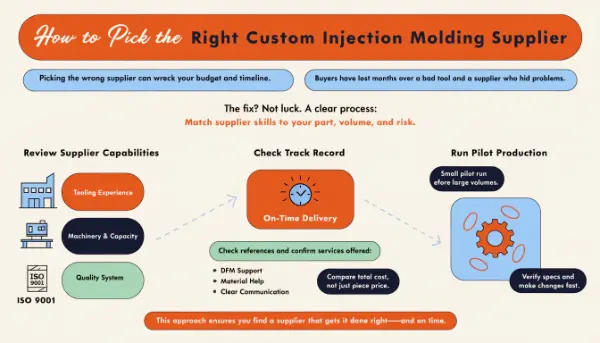
Picking the wrong molding supplier can wreck your budget and your timeline. I have seen buyers lose months over a bad tool and a supplier who hid problems. The fix is not luck. It is a clear process that matches supplier skills to your part, your volume, and your risk. Let me walk you through it.
To choose a custom injection molding supplier, match their experience, machinery, and quality systems (like ISO 9001) to your product needs. Check their track record for on-time delivery, review references, and confirm they offer DFM support, material help, and clear communication. Compare total cost, not just piece price, and run a small pilot before committing to large production volumes.
I built my career sourcing molds, so I know how stressful this choice feels. Below I break down the real questions buyers like Jacky ask me, and I give you the honest answers I wish someone had given me early on.
How Much Does a Custom Injection Mold Cost?
You send out an RFQ and get quotes that swing wildly. One supplier says $3,000. Another says $30,000. It feels like guessing. The truth is that mold cost hides in details most quotes never explain, and that gap can burn you later.
A custom injection mold typically costs between $1,000 and $80,000 or more. Simple, single-cavity aluminum molds for low volume can cost $1,000–$5,000. Complex steel molds with multiple cavities, hot runners, or overmolding often run $20,000–$80,000+. Cost depends on part size, tolerances, cavity count, steel grade, and expected mold life. Always ask what the price includes and who owns the tool.
What Really Drives the Price
Mold price is not one number. It is many small choices. Let me show the main ones in a simple table.
| Cost Driver | Low Cost | High Cost |
|---|---|---|
| Mold material | Aluminum | Hardened steel (P20, H13) |
| Cavity count | 1 cavity | 8, 16, or more cavities |
| Part complexity | Flat, simple shape | Undercuts, threads, overmolding |
| Runner system | Cold runner | Hot runner |
| Expected life | 5,000 shots | 1,000,000+ shots |
Look at Total Cost, Not Just the Quote
I always tell buyers to think past the sticker price. A cheap tool can cost more over time. Ask about tool ownership, storage, and repair terms. Ask about material strategy. A good supplier helps you cut wall thickness to save resin. Ask how they set cycle time, since cycle time drives your per-part price. Then look at secondary steps like assembly, packaging, and freight. I ask for a total cost of ownership view over one to three years. This includes tooling amortization, scrap rates, and any price increases. This view shows the real cost and stops surprises later.
Which Company Is Best for an Injection Molding Machine?
You want a machine or a molder with the right machine, but every brand claims to be the best. This choice matters because the wrong tonnage or worn equipment ruins your parts. Guessing here is expensive.
The "best" injection molding machine depends on your part. Top machine brands include Arburg, Engel, Haitian, Sumitomo, and Milacron. For buyers sourcing parts, the better question is whether the supplier owns machines with the right tonnage, shot size, and precision for your part. Match the machine to your material, part size, and volume instead of chasing a single "best" brand.
Judge the Molder, Not Just the Brand
Most buyers do not buy machines. They buy parts. So I focus on the molder’s setup. I check the tonnage range and the number of machines. This tells me if they can handle my part size and if they can scale. I look at their tooling skills too. Can they build molds in-house? Do they know multi-cavity, hot runners, insert molding, and overmolding?
Match Machine to Material and Volume
Different resins need different machines. Here is a simple guide I use.
| Your Need | What to Check |
|---|---|
| Precision parts (PC, PEEK) | High-accuracy, servo-driven machine |
| Silicone parts (LSR) | Dedicated LSR injection system |
| Two-shot parts | Multi-material, rotary machine |
| High volume | Many machines, fast cycle capacity |
I also ask for a facility audit, in person or by video. I want to see the equipment, the workflow, and the cleanliness. A tour tells me more than any brochure. A supplier who welcomes an audit is usually one who has nothing to hide, and that builds my trust fast.
Is the Injection Molding Business Profitable?
Maybe you are a buyer thinking of vertical integration, or you just want to know if your supplier is stable. A supplier close to failure is a risk to your whole program. That worry is real and worth checking.
Yes, the injection molding business can be very profitable, but margins vary widely. High-volume runs with efficient tooling and low scrap deliver strong profits. Low-volume or highly custom work has thinner margins due to setup and tooling costs. Profit depends on machine utilization, material cost control, cycle time, and labor. A well-run molder often sees 10–25% net margins.
Why Profit Matters to a Buyer
A profitable supplier is a stable supplier. I care about this because I want a long-term partner. A molder losing money may cut corners, delay orders, or vanish mid-project. So I look for signs of health. High machine use means steady work. Low scrap rates mean good process control. Fast cycle times mean efficient production. These signs point to a business that will still be here next year.
What Drives Molder Profit
Let me break the profit levers into a table so it is clear.
| Profit Lever | Effect on Margin |
|---|---|
| Machine utilization | High use spreads fixed cost, raises margin |
| Cycle time | Faster cycles mean more parts per hour |
| Scrap rate | Low scrap saves material and rework cost |
| Material buying | Bulk buying cuts resin cost |
| Automation | Robots cut labor cost on long runs |
When I audit a supplier, I ask soft questions about these areas. I do not need their exact numbers. I just want to feel that they run a tight ship. A molder who talks openly about scrap rates and cycle times shows me they measure and improve. That kind of partner protects my supply chain and my peace of mind.
Who Is the Largest Injection Molder in the US?
You want scale and reliability, so you look to the big names. But size is not the whole story. A giant molder may ignore your small order, while a mid-size shop may treat you like a top client. Knowing the players helps you aim right.
Berry Global is one of the largest injection molders in the US, along with major players like Nypro (a Jabil company), Plastic Components Inc., and MGS Manufacturing. These companies run huge volumes for packaging, medical, and consumer goods. But the largest molder is not always the best fit. For custom, lower-volume work, a mid-size specialist often serves you better.
Big Molder vs. Mid-Size Specialist
Bigger is not always better. I have seen large molders reject small tooling jobs or slow-walk changes. A mid-size shop often gives faster answers and more attention. Here is how I compare them.
| Factor | Large Molder | Mid-Size Specialist |
|---|---|---|
| Volume capacity | Very high | Moderate to high |
| Attention to small orders | Often low | Usually high |
| Flexibility on changes | Slow, formal | Fast, direct |
| Engineering support | Structured, deep | Personal, hands-on |
| Minimum order quantity | Often high | Often lower |
Choose Based on Fit, Not Size
I always match the supplier to my project profile. For a huge, stable, high-volume run with tight regulatory needs, a large molder makes sense. Their systems and traceability are strong. For custom parts, lower volumes, or projects that need design help, I lean toward a mid-size partner. They give DFM feedback, suggest cost cuts, and respond fast. I also keep a backup supplier in mind. This protects me if my main source has a problem. Size is just one input. The real goal is a partner who fits your part, your volume, and your timeline, and who talks to you honestly when trouble hits.
Conclusion
Choosing a custom injection molding supplier is not about the biggest name or the lowest quote. It is about fit. Clarify your part, material, and volume first. Then check technical skills, quality systems, and total cost. Run a small pilot before you commit. Watch for red flags in communication and tool ownership. Do this, and you will find a stable, honest partner who protects your product and your budget.
Use our injection molding service scope as a practical reference when comparing DFM, tooling, sampling and production support.