
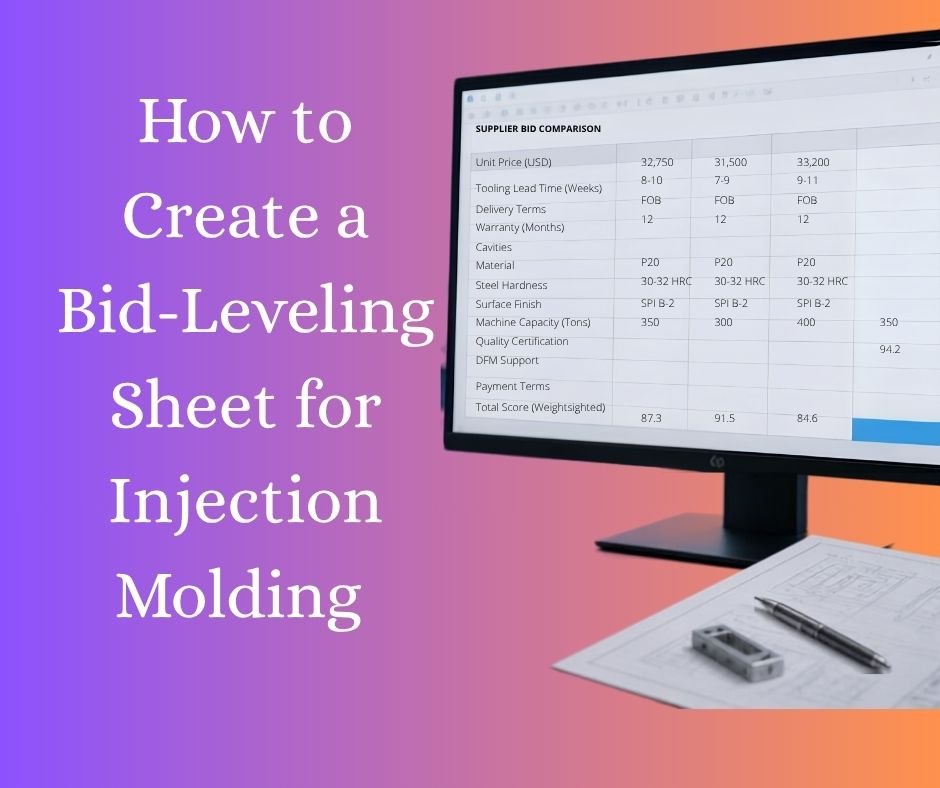
How to Create a Bid-Leveling Sheet for Injection Molding
When two injection molding quotes arrive, price is often the first number a buyer notices. However, price alone does not tell the full story because suppliers may base their quotations on different assumptions about cavity count, mold life, steel, cycle time, material cost, scrap, quality requirements, tooling scope, and shipping. A bid-leveling sheet places these details side by side so that buyers can compare the quotations on an equal basis. This article will give you all the information required for how to create a bid leveling sheet for injection molding.
| Question | Answer |
|---|---|
| How to create a bid leveling sheet for injection molding? | Start with including the buyer requirements and quotations from each supplier and compare the costs, tooling, production details, exclusions, and assumptions. |
What Is a Bid Leveling Sheet?
It is a document that allows the buyer to compare quotes from suppliers on an equal basis because it aligns all of the quotes on the same page. The sheet gives you the ease to go through the details of everything from tooling, production, quality, commercial terms, assumptions, to exclusions.
Bid Leveling vs. Simple Quote Comparison
When you make just a simple and quick comparison, you will only look for the answer –
“Which supplier has the lower price?”
But on the other hand, if you do a bid leveling comparison, there you are looking for the answer to the question –
“Are both suppliers actually quoting the same thing?”
For example, Supplier A may quote $18,000, but the price does not include shipping and T1 corrections. Whereas Supplier B may quote $20,000, but it includes both. So, just by looking only at the price, Supplier A seems cheaper, but the two quotes are not really comparable.
Bid leveling checks the differences in scope, technical requirements, assumptions, exclusions, and commercial terms.
So, from this example, you might have got an idea why two suppliers may quote different prices for the same project.
Why Injection Molding Needs a Specialized Bid Leveling Sheet
In an injection molding quote, there is much more than just mold cost. Cavity count, cycle time, part weight, resin cost, scrap, and mold life all can affect the price. Inspection, secondary operations, packaging, shipping, and Incoterms also add to the cost.
In a specialized bid leveling sheet, all these details are together, and it shows where the supplier quotes differ.
How to Create a Bid Leveling Sheet for Injection Molding
When you are reviewing the injection molding quotes, the bid leveling sheet is used to compare apples with apples. This means all suppliers should quote against the same technical and commercial scope.
Step 1 — Start with the original RFQ requirements
The original RFQ requirements sent to the mold makers should be listed in a column labeled on the sheet as “Buyer Requirement”.
For example:
| Requirement | Buyer Specification |
|---|---|
| Material | PA66 GF30 |
| Annual volume | 100,000 parts |
| Mold life | 500,000 cycles |
| Cavities | Supplier recommendation |
| T1 | Required |
| Inspection | Full dimensional report |
Use this column as a reference against the RFQ that was sent to suppliers. See if they made any incorrect assumptions.
Mold life is normally expressed in cycles or shots. The number of parts produced depends on the cavity count. For example, a two-cavity mold rated for 500,000 cycles can theoretically produce 1,000,000 parts before accounting for scrap.
Step 2 — Add one column for each supplier
Add one column per supplier. Use this same spreadsheet to track bids from three suppliers, five suppliers, etc.
| Requirement | Buyer Requirement | Supplier A | Supplier B | Supplier C |
|---|---|---|---|---|
| Mold price | —- | $18,500 | $21,000 | $19,800 |
| Material | PA66 GF30 | PA66 GF30 | PA66 GF30 | PA66 GF30 |
| Cavities | Supplier recommendation | 2 | 4 | 6 |
| Cycle time | Supplier proposal | 35 sec | 42 sec | 38 sec |
| Mold life | 500,000 cycles | 500,000 | 500,000 | 1,000,000 |
| T1 | Required | Included | Included | Extra |
| Inspection | Full dimensional report | Included | Included | Not stated |
You can see what each supplier has included and where their assumptions are different. For example, the higher tooling cost of Supplier B may be justified by greater production output, but this should be confirmed by comparing cycle time, annual capacity, and total program cost. And note that Supplier C lists the T1 as an extra cost, which must be compared with the conditions of the other suppliers.
Step 3 — Separate the quoted value from supplier assumptions
Do not mix all answers from different suppliers in one price field. Quotes and conditions must be clearly separated.
Useful fields include:
- Quoted
- Included
- Excluded
- Assumption
- Not stated
- Buyer adjustment required
A blank or “not stated” field should not be treated as included until the supplier confirms it in writing.
For example, one supplier can give a quotation of $20,000 for a mold but it may not have T1 corrections. However, another supplier can include them in their quotation. So, comparing the prices without knowing such differences is vague.
Step 4 — Normalize technical differences
When we talk about technical assumptions, they have a major role as these have the ability to change both tooling cost and production cost.
For example:
- Supplier A: 2 cavities, 35-second cycle
- Supplier B: 4 cavities, 42-second cycle
As more cavities raise the mold cost but can also produce more parts in each cycle. If there is a longer cycle time, it can reduce output even with more cavities.
So, it is advisable to check the cavity count, cycle time, shot weight, machine size, expected output, and tooling cost. Once you have all these details, you get a clear picture of what each supplier is actually offering.
Step 5 — Compare Commercial Terms
Record the:
- Currency
- Payment terms
- Freight
- Incoterms
- Packaging
- Taxes
- Duties
- Tooling ownership
If you are dealing with an export project, it is good to check whether shipping and import-related costs are included or left to the buyer.
Step 6 — Record unresolved questions
One column should be for Open Item / Supplier Clarification.
It can be used to make lists of any item that remains unclear.Like you might want to ask about whether T1 corrections, spare components, inspection reports, or freight are included.
Always record the supplier’s response in the sheet. This will provide an audit trail and make the final comparison easier for you to review.
When all the steps are done, you can compare the suppliers on a common basis rather than comparing the prices alone.
How to Find Supplier Assumptions and Quote Exclusions
When you first look at the supplier quote, it may look complete to you at first sight. However, there may still be some expenses or specifications that may not be mentioned.
Supplier Assumptions
When certain information is lacking in the RFQ then suppliers start making assumptions. They can, for instance:
- use a different resin grade
- assume a lower annual volume
- use standard mold steel
- assume fewer quality requirements
- assume that the buyer will provide the material
- leave freight to be paid by the buyer
- take advantage of the existing machine capacity
- use standard packaging
When suppliers make such assumptions, it can affect the final price. So, it would be best to write them in your bid leveling sheet rather than marking them as a real requirement.
Quote Exclusions
Carefully read the quote and search for the words “not included,” “excluded,” “optional,” “customer supplied,” “if required,” “additional cost,” or “TBD.”
For instance, a supplier might not include freight, inspection reports, spare inserts, or T1 corrections. But you can see these items covered in the price quoted by another supplier.
This is necessary especially when you are learning how to create a bid leveling sheet for injection molding.
Create an Exclusions Register
| Supplier | Exclusion | Estimated Impact | Clarification Needed | Final Decision |
|---|---|---|---|---|
| A | Freight | $1,200 | Confirm destination | Open |
| B | CMM report | $800 | Add to quote | Open |
| C | Spare inserts | $500 | Required? | Buyer decision |
Use this table with the main bid sheet. When the supplier responds to any clarification asked by you, you can update it here. It provides you with a good record of what has been included, what has been excluded, and what remains to be decided.
Worked Example: Normalize Two Injection Molding Quotes
Suppose that you have two quotes from suppliers for the same plastic part. By looking at the numbers, you may feel comparison is easy.
| Item | Supplier A | Supplier B |
|---|---|---|
| Mold cost | $18,000 | $24,000 |
| Cavities | 2 | 4 |
| Mold life | 500k shots | 1M shots |
| Cycle time | 30 sec | 38 sec |
| Part price | $1.15 | $0.82 |
| Inspection | Basic | Full dimensional |
| T1 | Included | Included |
| Freight | Excluded | Included |
| Packaging | Basic | Export packaging |
Here, a bid leveling sheet plays a huge role. Rather than skimping on costs to choose the price from the very first price comparison, it would be wise to use the sheet to find the differences first.
For example, the buyer might want to ask:
- Why does Supplier B choose to have a longer cycle time?
- Do they require a four-cavity design for the production volume?
- What is included in the basic inspection?
- What freight cost should be added to Supplier A?
- Does Supplier A’s packaging meet the export requirement?
- Are both suppliers using the same material and production assumptions?
Supplier A’s theoretical output: 2 cavities × 3,600 ÷ 30 seconds \= 240 parts/hour
Supplier B’s theoretical output: 4 cavities × 3,600 ÷ 38 seconds \= approximately 379 parts/hour
Additional tooling cost for Supplier B: $24,000 − $18,000 \= $6,000
Unit-price saving: $1.15 − $0.82 \= $0.33
Break-even volume: $6,000 ÷ $0.33 \= approximately 18,182 parts
At 100,000 parts:
Supplier A: $18,000 + ($1.15 × 100,000) \= $133,000, excluding freight
Supplier B: $24,000 + ($0.82 × 100,000) \= $106,000, including freight
These calculations are useful for normalizing the two quotes, however other factors are also there which are relevant to the comparison. These include OEE, yields, scrap rates, maintenance, level of required process control, packaging, logistics and other related areas.
There may be some differences that are intentional and acceptable. While some may require a price change or a new estimate.
The goal of injection molding bid evaluation isn’t just to discover the cheapest bid number. It is to ensure that you know what each supplier is providing so that you can compare their quotes on the same level.
Understanding T1 Costs and Corrections
There should be a distinction between T1 costs rather than being treated as one general cost.
- Trial and sample costs in T1 cover the costs of mold trial and sample runs.
- T1 corrections cover costs related to adjustments of tools to meet the approved drawing.
- Customer-requested design changes or ECNs are different. These are changes requested by the customer after the approved design or agreed scope and are normally charged separately.
A bid-leveling sheet should therefore record these items separately whenever the supplier’s quotation provides enough detail to do so.
Audit Trail Example: From RFQ Requirement to Final Approval
Bid leveling is normally used before a supplier is selected. After the order is awarded, the same record can be extended into a decision log to track DFM comments, mold-design decisions, T1 results, corrections, and final approval.
You can check it by just following this chain:
RFQ Requirement → DFM Comment → Mold Feature → T1 Result → Final Approval
For example, suppose a part has a critical manufacturing dimension with a tight tolerance.
RFQ requirement:
The dimensional tolerance for the mounting feature should be within the specified tolerance.
DFM comment:
The supplier identifies a risk of warpage and suggests the addition of cooling near the feature.
Mold feature:
The agreed cooling channel is added to the mold design.
T1 result:
The first trial sample is not within tolerance.
Correction:
The supplier makes a change in the process and/or a mold adjustment as required.
Final approval:
A subsequent sample is taken, which satisfies the agreed dimensional requirement and is approved.
| Stage | Requirement / Decision | Supplier A | Supplier B | Final Status |
|---|---|---|---|---|
| RFQ | Critical tolerance | Included | Included | Required |
| DFM | Cooling recommendation | Proposed | Not stated | Supplier A adopted |
| Mold | Dedicated cooling | Included | Not stated | Confirmed |
| T1 | Dimension result | Pass after correction | Pending | Approved |
When you have all these details, the buyer gets clear information of what was requested, what the supplier recommended, and what happened during the tooling process.
How to Structure a Bid-Leveling Sheet in Excel or Google Sheets
When you want to know how to create a bid leveling sheet for injection molding in Excel or Google Sheets, start with a simple column structure:
- Column A: Requirement
- Column B: Buyer requirement
- Columns C–E: Supplier quotes
- Column F: Normalized value
- Column G: Difference
- Column H: Supplier assumption
- Column I: Quote exclusion
- Column J: Buyer decision
As per requirement, you can use the remaining columns for any clarification points.
You can use the same setup for an online spreadsheet.
Common Mistakes When Creating an Injection Molding Bid Comparison
A very common and most recurring issue is when buyers just compare the numbers and don’t see what is actually behind those numbers.
| Mistake | Why It Causes Problems |
|---|---|
| Comparing only mold cost | Do not consider the cost of the recurring element. |
| Comparing only part price | Hides tooling and process assumptions. |
| Ignoring cavity count | Production output may not be comparable. |
| Ignoring cycle time | Cycle time mainly affects production output, machine hours, capacity, and unit cost. |
| Blank fields will be assumed as included | Not all items are necessarily represented in the blank field. |
| Ignoring quote exclusions | Items that go missing may be additional costs later on. |
| Comparing different Incoterms | There may be varying shipping fees and responsibilities. |
Final Bid Leveling Checklist
Before approving an injection molding supplier, confirm:
- CAD/drawing revision
- Material
- Annual volume
- Cavity count
- Mold life
- Steel/tooling scope
- Cycle time and part price
- Quality/T1 requirements
- Lead time and commercial requirements
- Assumptions, exclusions, and open items resolved
Conclusion
By now you have learnt that a bid-leveling sheet is not only about comparing prices. It’s about understanding what is actually in the quotes, and see the assumptions, and check the additional hidden costs. So, start comparison by putting the quotes side by side, to get a much clearer picture before choosing a supplier.
Send us your CAD files and project requirements to receive a clearly itemized injection molding quotation covering tooling scope, production assumptions, quality requirements, and commercial terms..
FAQs
What is the difference between bid leveling and quote comparison?
In quote comparison, you look at prices and terms, while bid leveling makes sure that all suppliers are quoting on the same scope.
What supplier assumptions should I check before approving a quote?
You should check material, tooling scope, production volume, lead time, quality requirements, shipping terms, warranty, and any exclusions or extra costs.